SAN FRANCISCO — This is supposed to be the season when star forward Paolo Banchero and the Orlando Magic improve hand in hand.
That has not happened. At least not yet.
One-third of the way through their schedule, despite injuries to key players and one of the league’s most difficult schedules so far, the Magic remain solidly in the hunt to host a first-round playoff series. That’s the good news.
But the bad news is that the team is 16-13, one victory behind its win total through 29 games last season, and Banchero has not yet made the sustained jump that he had wanted.
Outside the organization, the biggest question about the Magic’s short- and long-term viability on the court revolves around the Banchero-Franz Wagner pairing. Banchero has heard the chatter that the Magic play more smoothly and more effectively when he and Wagner play separately instead of together. When The Athletic asked him during the team’s current four-game road trip about that perception, Banchero provided a straightforward, unvarnished response.
“I think that’s bull—,” Banchero answered. “I’m not going to lie. People are going to say whatever they want to say about me, Franz and whoever. But we know that we’re at our strongest when both of us are out there on the floor.
“People say that the ball moves more (when only one of us is out there). I don’t think that’s true, honestly. I think sometimes you beat teams or you play certain games and it may look that way, but if you really watch and analyze, we play the same way every game. Nothing changes when somebody is out. We play the same way, especially on offense. Nothing really changes. I don’t buy too much into that (perception), but it is frustrating to see that and hear that just because, like I said, we’re at our best when both of us are out there.”
The two stars’ offensive games are similar. Perhaps too similar. Banchero and Wagner are at their best with their basketball in their hands, attacking the basket on mismatches or drawing so much defensive attention that they spray the ball out to the perimeter. Banchero and Wagner also have the same key weakness: their shooting. Banchero is a career 31.4 percent 3-point shooter, and Wagner, despite an uptick this season, is a career 32.5 percent 3-point shooter.
Banchero and Wagner have played a total of 286 minutes together this season, and when the Magic deploy that two-man lineup, the Magic have outscored opponents by 4.0 points per 100 possessions. That’s good, but it’s not the overwhelming impact typically expected from two players locked in on maximum-salary deals. Banchero’s five-year, $241 million contract extension will begin with the 2026-27 season and would balloon to approximately $287 million over five years if he makes an All-NBA team this season. Wagner is in the first year of a five-year, $224 million contract.
The counterargument is that Banchero and Wagner are young, still-developing players who have not yet hit their primes. Banchero turned 23 in November, while Wagner turned 24 in August. With more experience and, crucially, better outside shooting that could come in time, Banchero and Wagner should have the opportunity to silence their doubters in a way similar to how the Boston Celtics’ Jayson Tatum and Jaylen Brown eventually overcame the doubts about their pairing together.
At this exact moment, though, the Banchero-Wagner pairing is not an immediate concern. Wagner suffered a high-ankle sprain on Dec. 7, and his return is not imminent.
In a vacuum, Banchero’s overall numbers appear strong, with averages of 20.9 points, 8.6 rebounds and 4.5 assists per game. Measured against his three prior seasons, however, he has taken steps backward; his scoring average is the second-lowest of his career, and his 3-point shooting percentage has dipped to a career-low 23.7 percent.
The most obvious explanation for Banchero’s shooting downturn is a familiar one: an injury. Last season, injuries forced him to miss 36 games, with the most significant injury, a torn oblique muscle, sapping his conditioning and limiting his explosiveness for an extended stretch after he returned. This season, a groin strain kept him out 10 games, and although he returned on Dec. 5, he is still working back into a rhythm.
“It was definitely a setback,” Banchero told The Athletic. “Nothing major, but definitely a minor setback. Just frustrating. But I was able to just focus on the rehab process and then get back on the court (as) quick as possible. I knew coming back that, with it being a groin injury, it would take some time. But I’ve been feeling better, and I’m looking forward to just kind of taking off and really finding my feet and starting to play some really good basketball.”
On Monday night, Banchero played perhaps his best game since his return, scoring 21 points, collecting 12 rebounds and dishing out seven assists.
But it wasn’t enough, not with Wagner sidelined and guard Jalen Suggs out because of a hip contusion. The Magic lost to the Golden State Warriors 120-97 at Chase Center.
Orlando has compiled a mediocre 9-10 record in the games Banchero has played but an impressive 7-3 record in the games he missed. Some valid reasons might explain the discrepancy — and we’ll get to those in a moment — but on the surface, the team’s stronger performances without him contradict the notion that Banchero is the franchise’s most indispensable player.
Banchero, perhaps, is Orlando’s most talented offensive player. Wagner, meanwhile, is the team’s best two-way player. Newcomer Desmond Bane is the Magic’s most reliable shooter and a key late-game scorer. And Suggs is the team’s X-factor, someone who is so crucial with his energy and his point-of-attack defense that he makes everyone around him better.
The Magic’s preferred starting lineup of Suggs, Bane, Wagner, Banchero and center Wendell Carter Jr. has outscored opponents by 18.0 points per 100 possessions , making it one of the better quintets in the NBA. For comparison’s sake, consider that the Oklahoma City Thunder’s most commonly used lineup so far this season — the grouping of Shai Gilgeous-Alexander, Luguentz Dort, Cason Wallace, Chet Holmgren and Isaiah Hartenstein — has outscored opponents by 18.3 points per 100 possessions. For Orlando, that’s good company to keep.

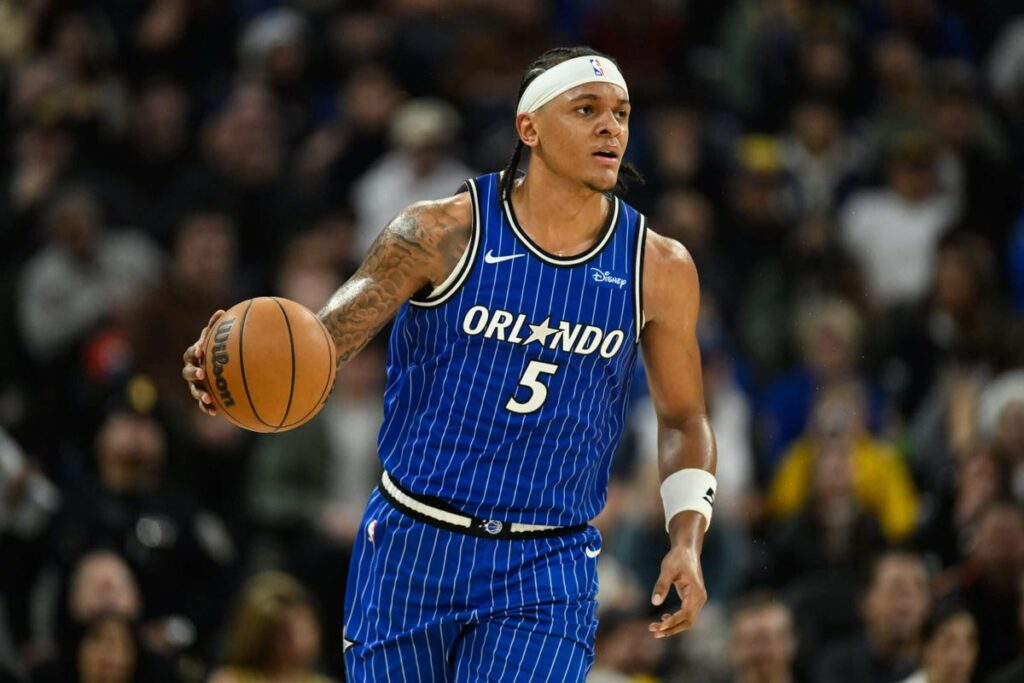
Paolo Banchero takes issue with the notion that the Magic play more smoothly on offense when he and Franz Wagner play separately. (Mike Watters / Imagn Images)
The success of the Suggs-Bane-Wagner-Banchero-Carter lineup indicates that the Magic have a legitimate chance at least to reach the second round in the East if they remain healthy. The problem is that the quintet has played only 117 minutes together because of the injuries to Banchero, Wagner and early-season caution with Suggs’ minutes following Suggs’ knee-cartilage surgery in March.
The Magic struggled during their first five games of the season, a span in which Banchero and Wagner both played heavy minutes but the team still went 1-4. Those issues primarily stemmed from the entire team adjusting to coaches’ heightened emphasis on pushing the pacelearning how to integrate Bane into the offense after his offseason trade and Suggs’ limited minutes.
Once the team started to find its footing, with a strong first quarter on Nov. 12 during a road victory against the New York Knicks, Banchero suffered the groin injury.
Wagner played like an All-Star during Banchero’s absence, Bane began to feel more comfortable with his role and his new teammates and Suggs started to resemble his old self.
In the game that Banchero returned, the Magic improved to 14-9, and the team looked like it could catapult itself up the East standings.
But Wagner suffered his high-ankle sprain during Banchero’s second game back. Suggs injured his hip six days later, during Orlando’s NBA Cup semifinal loss to the New York Knicks.
Banchero continues to shine as a passer. When opponents double-team him, he eagerly passes the ball, assisting on 21.2 percent of his teammates’ made shots, according to the NBA Stats database.
“There’s not many things on that court he can’t do, and that’s one of his strengths,” Carter said. “He understands how much gravity he brings towards him. He trusts his teammates, so he always makes the right play. It’s impressive, though. At 6-10, it’s hard to do, and he’s fantastic at it. One of the best.”
Banchero has remained strong attacking the rim and has been one of the sport’s most elite players at drawing shooting fouls. But he struggled with his 3-point shooting before his groin injury, shooting 25.0 percent, and has struggled since his return from the injury, shooting 21.9 percent from 3.

Paolo Banchero is a gifted passer for a 6-foot-10 forward. (Rob Gray / Imagn Images)
Many of his midrange and long-range shots over the last three weeks have been short, a sign that he’s still regaining the strength in his legs.
He expects an upturn.
He has reason for optimism. Last season, his oblique tear prevented him from jogging and running for weeks, and it took him weeks to regain that conditioning. But once he did, he played some of the best basketball of his pro career over his final 20 games of the regular season, averaging 29.7 points on 49.2 percent shooting from the field and 35.2 percent shooting from 3-point range. During the Magic’s first-round playoff series against the Boston Celtics, he averaged 29.4 points per game, shot 43.5 percent from the field and 44.4 percent from 3.
He remains the focus of opposing defenses now, and when Wagner and Suggs return from their injuries, Tristan da Silva comes back from a shoulder contusion and Moe Wagner comes back from a year away because of an ACL tear, Banchero could encounter less attention from opposing defenses.
Since his return, he has prioritized his passing.
“His ability to be aggressive, get downhill, attack the basket — he’s creating mismatches all over the floor,” coach Jamahl Mosley said.
The Magic entered this season with high expectations. There’s still plenty of time to fulfill those expectations — if the team can stay healthy and if Banchero makes the strides he, his teammates and his coach think he can make.
“You always feel the weight of the expectations,” he said. “But at the same time, you want to go out there and just play the game that you fell in love with as a kid and have fun. But there’s definitely a lot of expectations, but it’s never too much, though.”
Source link